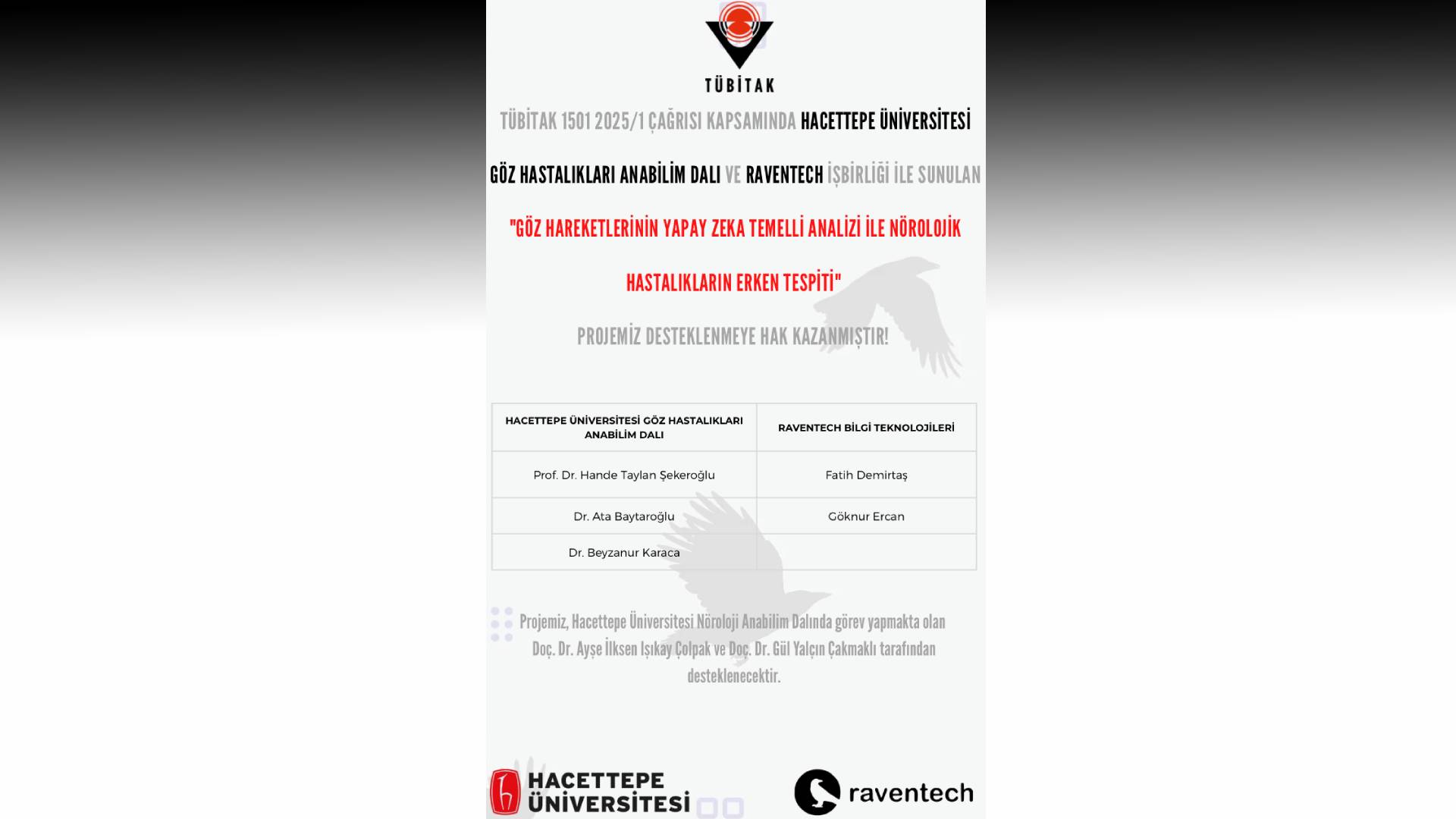
Hacettepe University has taken a new step in pioneering scientific innovation. The project titled “AI-Based Analysis of Eye Movements for Early Detection of Neurological Diseases” has been awarded funding under the TÜBİTAK 1501 Industrial R&D Projects Grant Program, 2025/1 call.
The study will be jointly conducted by the Hacettepe University Department of Ophthalmology and Raventech Information Technologies. The research team includes Prof. Dr. Hande Taylan Şekeroğlu, Dr. Ata Baytaroğlu, and Dr. Beyzanur Karaca from the Department of Ophthalmology, while Engineer Fatih Demirtaş and Göknur Ercan will contribute on behalf of Raventech.
In addition, the project will receive scientific support from the Hacettepe University Department of Neurology, with contributions from Assoc. Prof. Ayşe İlksen Işıkay Çolpak and Assoc. Prof. Gül Yalçın Çakmaklı.
The main objective of this study is to compare the eye movements of participants with neurodegenerative diseases against a healthy control group through non-invasive techniques, and to establish a device infrastructure that can measure a wider range of eye movement parameters with higher sensitivity. In this way, eye-tracking data can be used as a biomarker for conditions such as Alzheimer’s disease, where early diagnosis is of critical importance.
In the project, eye movements recorded during three-dimensional visual tasks will be analyzed with the support of artificial intelligence. This approach is expected not only to enhance diagnostic processes in neurology but also to create awareness and provide objective measurement opportunities in other medical fields, ultimately contributing to improved clinical management and patients’ active participation in daily life.
The outcomes of this study are expected not only to improve diagnostic processes in the field of neurology but also to provide opportunities for early diagnosis, clinical suspicion, and objective measurement in other medical specialties; moreover, they are anticipated to strengthen the clinical management of patients and enhance their active participation in daily life