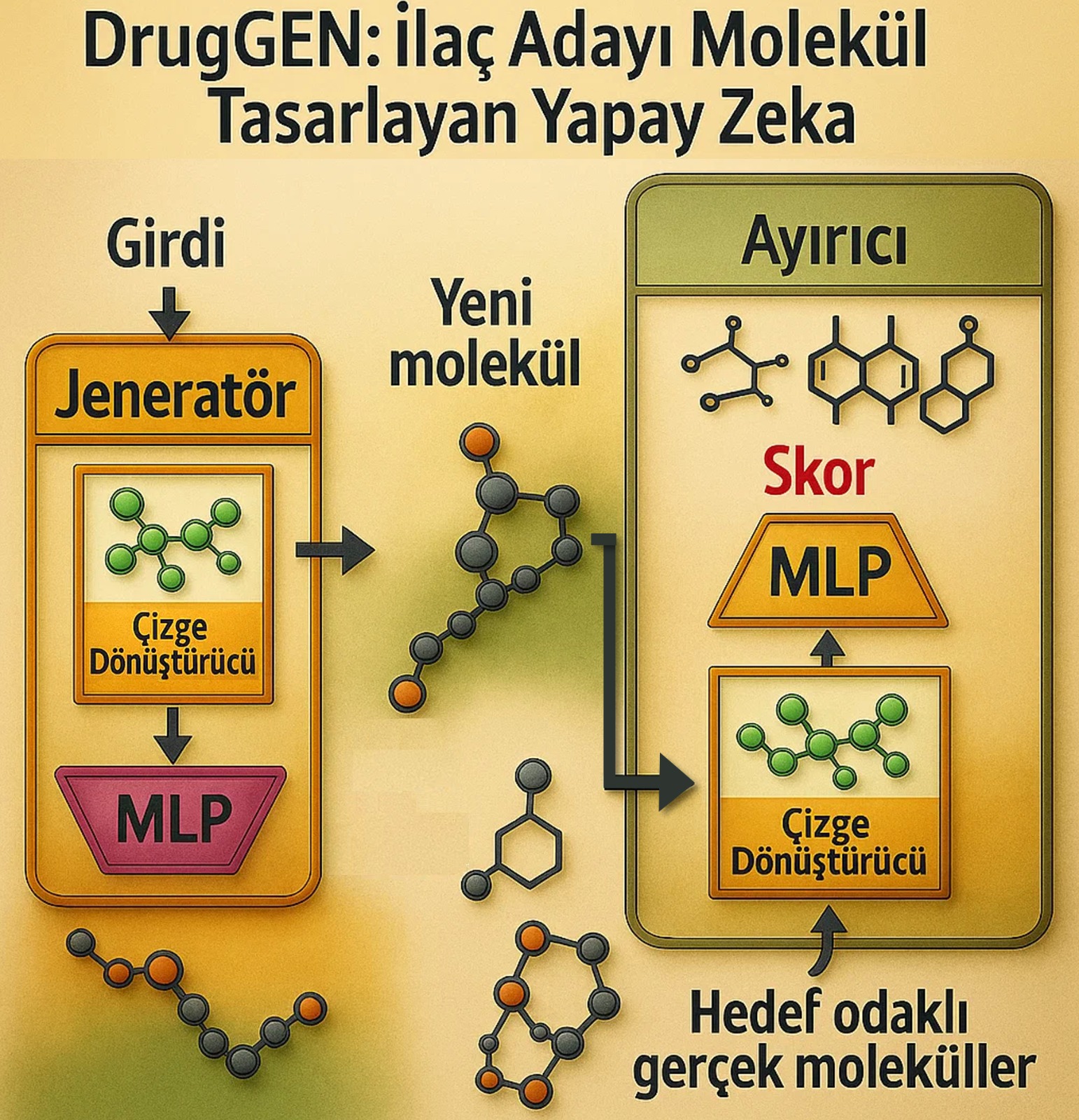
Hacettepe University scientists have developed a generative-AI method for designing target-specific drug-candidate molecules. The work, led by Prof. Dr. Tunca Doğan (Department of Computer Engineering; Head, Department of Health Informatics, Institute of Informatics) and the Hacettepe Biological Data Science Lab, has been published in Nature Machine Intelligence.
In the study, the system named DrugGEN introduces, for the first time under a single framework, an architecture that combines Generative Adversarial Networks (GANs)—successfully used in recent years in natural language processing and synthetic image generation—with graph-transformer-based deep learning methods. In the work, molecules were represented as graph structures over atoms (nodes) and bonds (edges), and specialized layers capable of learning on these graphs captured the properties of chemical structures. This architecture brings together the strong feedback mechanism from the generator–discriminator structure of GANs and the ability of graph transformers to model complex molecular relationships. In this way, de novo molecules conditioned on a specific protein target could be designed.
Contribution to cancer research
As a proof of concept, the cancer-related protein AKT1 (a kinase) was selected as the target. Among thousands of AI-designed molecules for this target, five were synthesized and tested in the laboratory. Two of these molecules succeeded in inhibiting the target protein at meaningful levels. Binding-oriented explainability analyses (attention maps) and molecular dynamics findings showed that the model can capture target-specific interactions.
Why it matters
The study demonstrates that generative AI in drug discovery not only offers speed and cost advantages, but can also reveal entirely novel molecule candidates that have not been discovered before—thereby making major contributions to the development of new treatments against diseases. In line with scientific transparency and community benefit, all code, pretrained models, dataset versions, and result artefacts have been made openly available.
Project team
The research was conducted under the leadership of Hacettepe University, with collaborators from METU and Gazi University, and was supported by TÜBİTAK 2247 National Leading Researchers Programme. Among the article’s authors are Atabey Ünlü*, Elif Çevrim*, Melih Gökay Yiğit*, Ahmet Sarıgün, Hayriye Çelikbilek, Osman Bayram, Dr. Deniz Cansen Kahraman, Dr. Abdurrahman Olğaç, Dr. Ahmet Süreyya Rifaioğlu, Prof. Dr. Erden Banoğlu, and Prof. Dr. Tunca Doğan (*: co-first authors). The fact that the entire study was carried out in Türkiye indicates a strengthening research medium at the intersection of generative-AI and health domains in our country.
Links
Article link: https://www.nature.com/articles/s42256-025-01082-y
Free full-text access to the article: https://rdcu.be/eGoHv
Source code, data, and models: https://github.com/HUBioDataLab/DrugGEN
Demo: https://huggingface.co/spaces/HUBioDataLab/DrugGEN