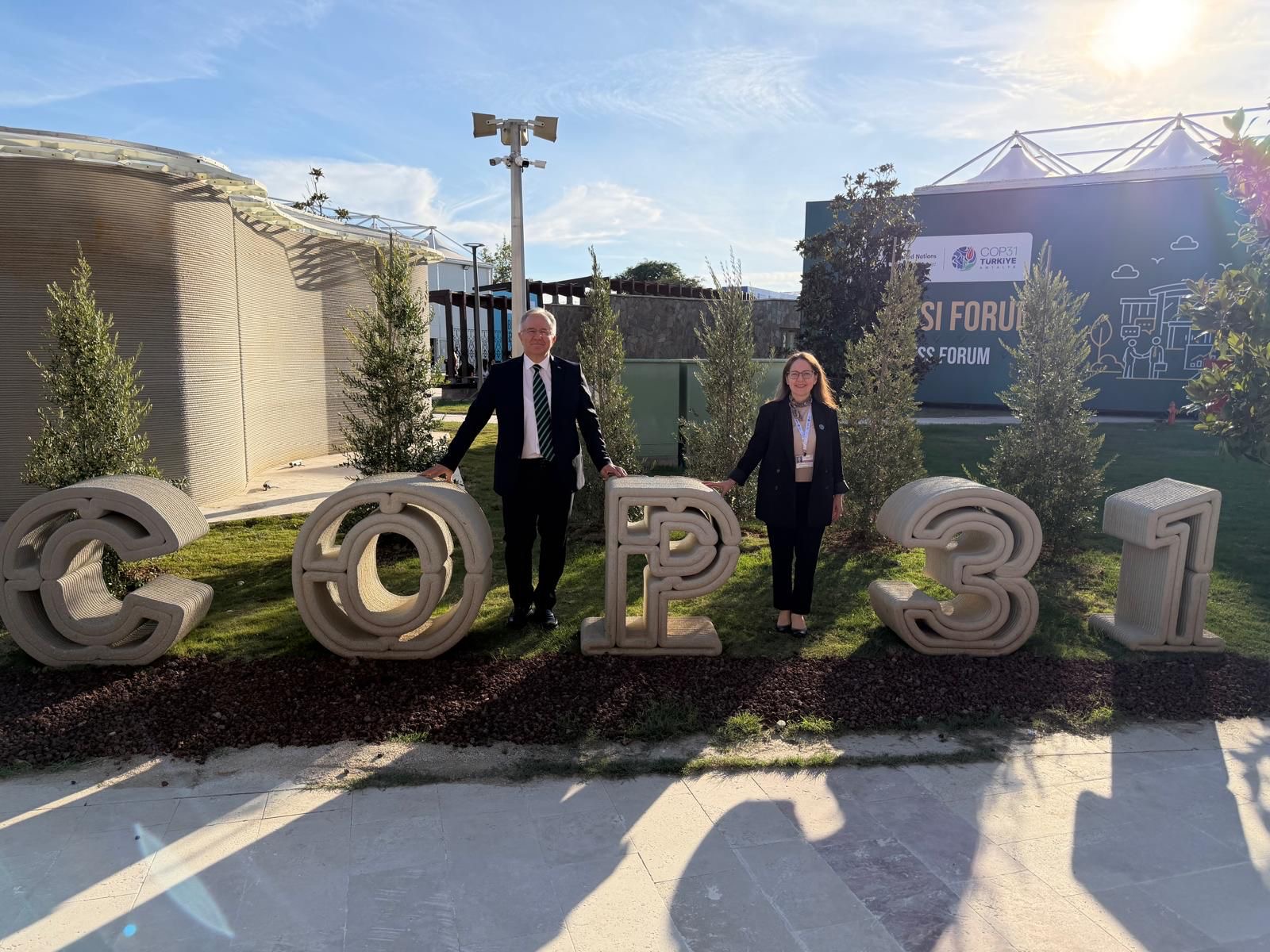
At the international panel titled “Climate, Health and Zero Waste: Campuses and Clinics,” organized by the Climate High-Level Champions’ Office and the Zero Waste Foundation as part of COP31, our university shared its sustainable campus practices, initiatives to reduce the environmental footprint of hospitals, and approach to integrating patient benefit with environmental sustainability in healthcare with international participants.
The international panel, held on 9 November 2026 at the Green Zone Zero Waste Hub in Antalya as part of the United Nations Climate Change Conference (COP31), was organized by the Climate High-Level Champions’ Office and the Zero Waste Foundation.
Moderated by Prof. Dr. Rana Atabay Kuşçu, Director of Istanbul Medipol University’s Research and Application Center for Sustainable Development and Twin Transformation (SURKAM), the panel featured Prof. Dr. Mine Durusu Tanrıöver, Director of the Vaccine Institute and Social Contribution Coordinator at Hacettepe University. Representing our university, she discussed its sustainability policies, initiatives to reduce environmental impacts on campuses and in hospitals, and approaches to developing climate-friendly healthcare services.
University Campuses as Living Laboratories for Sustainability
Emphasizing that universities should be regarded not merely as institutions of education and research, but also as living laboratories where sustainable solutions are developed, implemented and evaluated, Prof. Dr. Durusu Tanrıöver shared examples of Hacettepe University’s work in this area.
She noted that, alongside the extensive natural areas and biodiversity potential of the Beytepe Campus, initiatives such as solar energy applications, zero-waste practices and free access to drinking water aimed at reducing single-use plastic consumption are key components of the university’s sustainable campus approach.
Highlighting the importance of integrating these practices with educational and research activities, she stated that campuses where students and researchers can measure environmental, economic and social impacts have the potential to develop sustainability models that can serve as examples for other institutions.
Initiatives to Reduce the Environmental Footprint at Hacettepe University Hospitals
The panel highlighted that the healthcare sector accounts for approximately 5% of global greenhouse gas emissions. It also emphasized that the environmental impact of hospitals is not limited to energy consumption and waste management; medical supplies, procurement processes, pharmaceuticals and supply chains must also be assessed holistically.
Discussing Hacettepe University’s work on zero waste, energy and water conservation, efficient management of medical supplies and sustainable healthcare services, Prof. Dr. Durusu Tanrıöver shared concrete examples of initiatives at Hacettepe University Hospitals to reduce their environmental footprint. These included waste separation at source, optimizing water and energy use in laundry operations, and proactively managing medical supplies approaching their expiration dates through advance planning. She also stressed that sustainability should be integrated into the daily operations of healthcare institutions through shared objectives across hospital management, procurement, clinical departments, infection control and support services.
Higher-Quality Healthcare with a Lower Environmental Impact
Another key topic addressed at the panel was the direct integration of environmental sustainability into clinical decision-making processes.
Prof. Dr. Durusu Tanrıöver emphasized that unnecessary tests, repeated imaging procedures and inappropriate medication use that provide no meaningful benefit to patients not only affect the quality of healthcare but also lead to unnecessary resource consumption and environmental burdens.
She noted that the high-value care approach can improve the quality of healthcare while reducing its environmental impact by prioritizing evidence-based interventions that provide genuine benefits to patients. The panel highlighted the holistic nature of Hacettepe University’s sustainability approach, which extends from the environmental management of campuses and resource use in hospitals to educational and research activities and clinical decision-making processes.
Rector Prof. Dr. Mehmet Cahit Güran Emphasizes Sustainability Awareness
Rector of Hacettepe University Prof. Dr. Mehmet Cahit Güran also emphasized that sustainability should go beyond institutional policies and technical practices to become a lasting behavioral model. Highlighting the importance of values-based education in achieving this transformation, Prof. Dr. Güran underlined the need to reflect sustainability awareness in individuals’ everyday choices and behaviors.
The panel emphasized that universities can lead the transition to sustainability by integrating scientific knowledge with their own practices, and that their contribution to society can be strengthened by measuring, improving and scaling up successful initiatives.
The experiences shared by Hacettepe University at COP31 demonstrated that environmental sustainability can be addressed alongside the quality of healthcare and patient safety. They also highlighted the potential for campuses to become living laboratories, hospitals to evolve into sustainable institutions, and clinical settings to serve as environments for delivering high-value care.